Dance Me Through the Panic till I’m Gathered Safely In
On the theme of “Navigating Safety and Fear in a Shifting Relational Field” by Charlie Jackson-Allen MSc GMBPsS MBACP
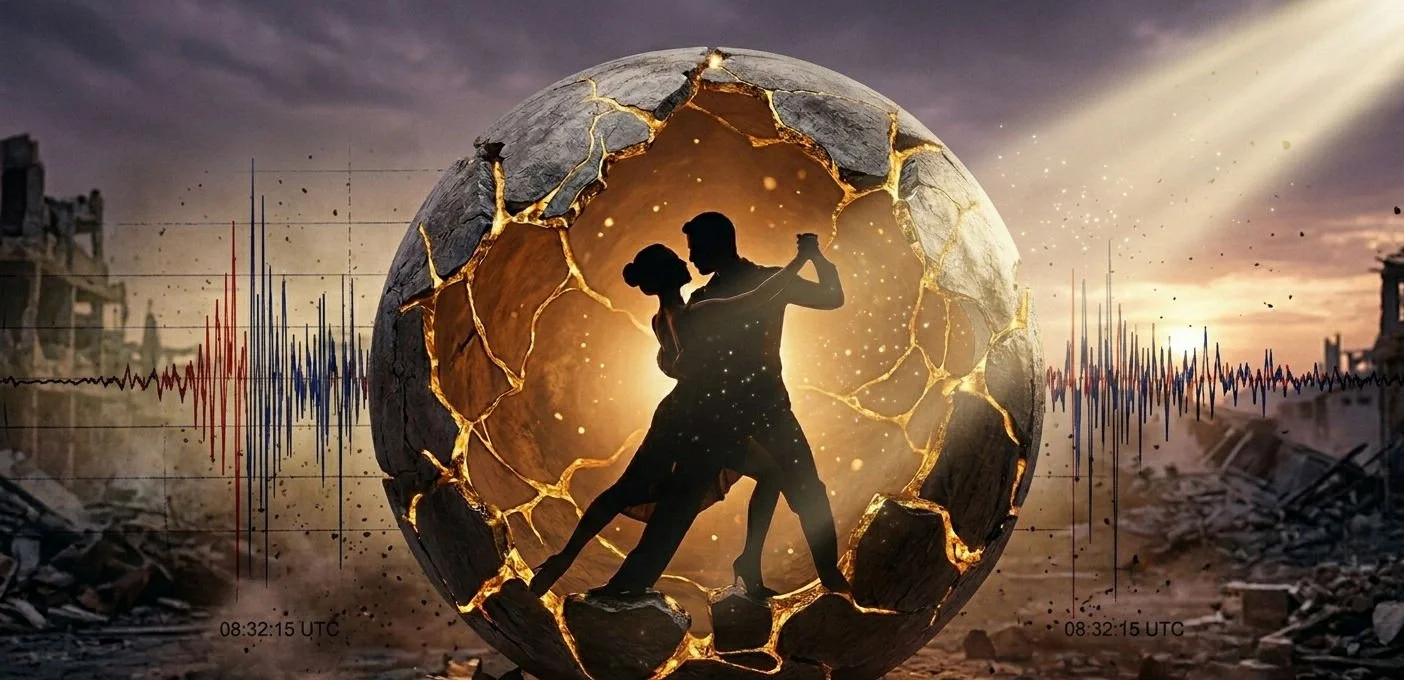
Dance Me Through the Panic till I’m Gathered Safely In
The therapeutic container, the cherished sanctuary wherein
safety can dwell, is becoming more porous to outside events.
Events like global conflict and environmental uncertainty bleed
through our boundaries and shake the shared ground of our safe
places. This shaking ground is no metaphor; rather, a potent and
present cohabited field phenomenon. The outside world is not and
has never been outside.
Atmosphere: The Ether of the Between
Acting Practitioner Michael Chekhov conceptualised “Atmosphere”
as more than a personal mood, but instead an objective, spatial reality –
an invisible “ether” surrounding all in a room. Here and Now, warfare and
global instability are a shared, stark, and unavoidable Figure, charging
the atmosphere with an electric heaviness formed from collective hyper-
vigilance.
This collective dread is not a symptom which we need to regulate
out of existence. By behaving as a detached observer in a separate
reality, we fall into a “Quantum Trap”. We can consider Karen Barad’s
“Agential Realism” (2007). Barad here suggests that we do not “interact”
with a world “out there”; instead, we “intra-act” within it. The fundamental
entanglement of therapist and client cannot be simplified to two stable
points meeting at a boundary; they are phenomena co-emerging from a
field vibrating with the discord of the world.
In the beautiful, often dissonant dance with a client, we cannot
pretend that the floor isn’t shaking. We cannot set the session in a
backdrop of purity, which simply does not exist within the field. Instead,
we must resonate and undulate with the waves in sympathy with the
ground – working as a resonant body to co-create a truer, situational
safety.
The Telemicroscopic Lens: Micro-Gestures as Global Resonance
Augusto Boal described the stage as a “telemicroscopic space”:
the smallest and most private gestures are brought into high-definition
focus yet remain inextricably linked to the larger-scale macro-forces of
the world. This telemicroscopic lens is a crucial and critical lens for the
phenomenological observer. If we ignore the larger scale resonances,
we are not creating a sanctuary; we are creating a clinical vacuum.
We are not here to create a sterile absence in which a practitioner
and client can politely flow together. This is antithetical to the Fertile
Void; there is no authentic “Now”, so there can be no “Now-for-Next”.
Through a telemicroscopic lens, the client’s shallow, sharp breath in the
throat, or a sudden clenching of a hand, is a micro-enactment of the
global field. Fear is not an interruption of the “real work”; it is the work. It
is the primary material of the encounter; if we ignore it, that constitutes
relational abandonment.
Karma Police Arrest this Man
It is easy for us to retreat into the clinical vacuum. All the
internalised voices and introjects that dictate what is permissible for us
to feel are strengthened in the face of the powerful fear caused by the
overwhelming swell of global uncertainty.
We must not let what Boal referred to as the “Cop in the Head”
interfere with our reaching our clients and with the intentionality of
contact (Spagnuolo-Lobb, 2013). It is easy for the client to listen to the
voice telling them to remain numb and vigilant, and for the therapist to
maintain a false “professional neutrality.” The “Cop” tells us that it is
unsafe to reach out, to touch, or to be moved.
We must move from being mere spectators of the client’s fear to
instead becoming Spect-actors (Jackson & Boal, 2005) within the
relational field. We must “break the fourth wall” of the clinical encounter
by acknowledging the shared tremors. The “Cop” is forced out of the
shadows and into the light by acknowledging that the terrors of war and
global uncertainty are in the room. The session can be transformed into
a rehearsal for relational citizenship – we can reach each other and
quieten the “Cop”.
Relational Safety Redefined
We are not co-creating safety in retreat from reality, far from it: we
are seeking to co-create a resilience of the between. Being “gathered
safely in” is not just finding shelter from the tremors but finding a
relational rhythm that can embrace the discord without collapsing into
the numbness of desensitisation. This is support not as a prop but as a
rhythm.
Safety in a rapidly changing field is a dynamic quality of situational
support. To provide the support necessary for healthy and spontaneous
“Now-for-Next” in a world at war requires a co-created confidence that
the “between” is strong enough to hold two shaking entities without
breaking contact. This is the psychophysical act of two dancers standing
on a shaking floor and, while the world falls around them, refusing to turn
from or release their hold.
Put on Your Red Shoes and Dance the Blues
In a war-torn field, we dance to resist. Not a graceful, pretty dance,
but an awkward and frightened dance. We choose to remain sensitive;
we are not a static support; we are the dance partner. We acknowledge
that our movements are co-constituted by the ground beneath us. The
smallest of gestures, the tiniest moments of vulnerability are practised
under the eyes of the “Cop” as a radical “Next”. The choice to remain
porous, “entangled”, and reachable is a revolutionary act of love.
We are tasked here as practitioners with more than regulation. We
are both the “Field-Regulators” and “Field-Resonators” of a discordant
global field. Are we helping our clients “adjust” to an unsafe world, or
instead, helping them rehearse a way of being within it that maintains
their humanity?
By integrating the radical agency of Boal with the relational fluidity
of Spagnuolo-Lobb, we can offer a place to temper the soul. We stand
amidst the earthquake, not as experts in tranquillity, but as resonant
partners in the dance. In a field of discord, is it our primary duty to find
the ‘right’ technique, or is it to become a more resonant instrument – one
capable of being played by the world’s grief? Even where there is no
floor, we can find the rhythm of the “We” – and in sharing that rhythm,
“We” are gathered safely in.
Bibliography
Barad, K. (2007). Meeting the universe halfway: Quantum physics and the entanglement of matter and meaning. Duke University Press.
Chekhov, M. (1953). To the Actor: On the Technique of Acting. New York: Harper & Row.
Jackson, A., & Boal, A. (2005). Games for actors and non-actors. Routledge.
Jackson, A., & Boal, A. (1995). The rainbow of desire: The Boal method of theatre and therapy. Routledge.
Spagnuolo-Lobb, M. (2013). The Now-for-Next in Psychotherapy. Gestalt Therapy Recounted in Post-Modern Society. Siracusa: Istituto di Gestalt HCC Italy Pub.
Charlie is a graduate psychologist and a Gestalt-oriented therapist, practising privately online and as part of the Neurodivergent Therapy Space team. He is an acting and performance tutor and a former international touring performer. You can find him on:
Instagram at @hellocreativecharlie and online at www.creativecharlie.co.uk